Wednesday, September 19, 2007

A Midsummer Night's Dream


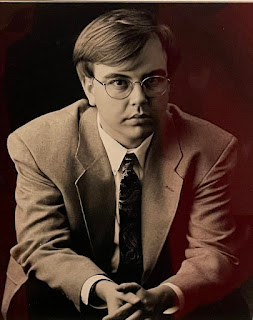
I haven't been this proud of a show since college. We're hitting on all cylinders with this one; the set and costumes are lavish, the acting top-notch, and you can't get better dramatic material. Jeff Soroka has done an outstanding job assembling this group and helming this production.

My lovely wife choreographed the fairies. You can read about that at her regular blog. (here, here, and here.) Very sensual, very sexy fairies! Hell, that alone is worth the price of admission!


Oh ... and I'm in it.
 
Come see it!

Thursday, September 13, 2007

What to Draw

From UNCLE EDDIE'S THEORY CORNER!: WHAT TO DRAW WHEN SKETCHBOOKING

It's a fact: You can learn much about your art form by studying other art forms.

An artist and theoretician I admire is Uncle Eddie, veteran animator and esteemed man of the world. On Tuesday he posted the above blog entry.

Here are two quotes to ponder:
"If you draw people as individuals you'll end up as often as not with cliches: the middle-aged guy with a gut, the fat woman wearing tight clothes, the guy nodding off while he tries to read his newspaper, etc. That's because ordinary people people look pathetic when you draw them in isolation."
"Where people come alive is in conversation. That's where they become psychological and fleshed out. Take the fat woman. When she's talking she's no longer just a stereotype, she's a human being with a point to get across. She's more interesting."
Hear, hear! This goes along with something David Mamet rails about, namely "Dead Kitten speeches." In order for dramatic literature to be dramatic, you must see the interplay of characters. Bad writing shuts down the forward momentum of a play so we can see just how boring a character is (i.e. a horrible monologue.)

A well-crafted monologue somehow creates the same effect good dialog creates; it moves you forward in the story.

Good food for thought!

Tuesday, September 04, 2007

The Mad Theatrics Journal


LAST CALL FOR ARTICLES!

UPDATED

The MAD THEATRICS JOURNAL is accepting submissions for our premiere issue! I should probably post some sort of submission guidelines, but this first issue is going to be very loose. Let's just say, keep the articles a reasonable length, somewhere around 2,000 words or less. There is no theme. Anything goes! We are looking for the following types of material:
  • Short plays
  • Theatre theory/history
  • Reviews
  • "How to" articles
  • Humor/satire
  • Photographs
This ezine shall be published in PDF format, with no support for hypertext. I, Andrew Moore, shall be the dictator-in-chief. Submissions (preferably a copy-and-paste-able file type: .txt, .doc, etc.) can be sent to me at scrapsflippy@gmail.com. If you have any questions, shoot me an e-mail or comment below.

(NOTE: This will be published under a "Attribution Non-commercial No Derivatives" Creative Commons license. Otherwise, authors will retain their own copyrights. I'm not planning on making any money on this venture. To read up on why I'm doing this, read this blog entry.)

UPDATE: I corrected it up above. 2,000 words or less. I don't want a novel, just an essay or article.

Monday, September 03, 2007

No Flying Monkeys ...

Seth on cheap advertising:
Mysteriously, when the ads are cheap (think banners, or cable or AM radio), the content is lousy.

A SuperBowl ad costs a few million dollars to run... so the beer companies and the dot com companies spend millions creating the ad, even if it runs only once. [...]

There's no economic reason for this. You can run that banner ad in a thousand places. You can run that radio ad in 200 cities. If the media is cheap, it might just be a good value. And if you can run an effective ad, you can run it far and wide and turn a profit.
I don't think it's that mysterious at all. When it comes to a Super Bowl Ad, there is much more money at stake. With banner ads or AM radio ads there's virtually nothing at stake.

This is true for entertainment, as well. Compare your run-of-the-mill improv show with Broadway's Wicked. It costs virtually nothing to put on an improv show; very little is invested so oftentimes you literally get what you pay for: an hour or two of diversion. Meanwhile great piles of cash are shoveled into a BIG-TIME BROADWAY SHOW. A huge investment! Also a better bet than your local run-of-the-mill improv show.

It's not just the investment of capital, and here's where the mystery truly vanishes: The artists involved understand the scope. The improv show is playing to friends and family or die-hard improv fans or folks too broke to cross the street to see Wicked at the Pantages. A small pool. The artists involved in a BIG TIME BROADWAY SHOW know that there will be lines around the block. The artists have more at stake with a bigger audience and so bring their "A" game. As for the group playing to a dozen people, half of them comped ... there is a difference.

(HOWEVER, the Broadway show could be a crass, mediocre piece of crap performed by jaded jerks. The little improv show could have more heart and sheer talent on display than all the theatre palaces in the world. These are the exception to the rule. Not every improv is "The Kids in the Hall" back in the day, and not every Broadway musical is "Annie 2.")

The thing to do is to bring your "A" game regardless, to not settle for mediocre, to be remarkable. There was a little show in Hollywood that opened earlier this year titled "All About Walken." It's eight actors doing Walken impersonations in scenes and monologues. The show went up the the Gleason Theatre on Hollywood Boulevard -- I've performed on stage there myself, in a show that averaged five audience members each night. Just a hole-in-the-wall storefront theatre. Certainly not the Pantages.


This play -- a play that cost next to nothing to produce (i.e. no flying monkeys) that features eight people doing Walken impressions for crying out loud -- got major media coverage. The show was consistently sold out. These same eight actors could've just done a mediocre improv show, but they didn't settle for that. They brought their "A" game, and they flourished.

So that's the lesson to take away from all of this: Don't throw away any opportunity to be remarkable, no matter how "low rent" the venue.

[Also posted at www.thefelties.blogspot.com.]

Friday, August 24, 2007

Antonin Artaud: A Poetry of Space -or- Theatrical Yoga

[NOTE: Please forgive this messy little essay. This is a work-in-progress. I was struggling with Artaud's theories back in March of this year, and this blog has been sitting around as a draft ever since. I took a break from Artaud, but I've decided to go ahead and clear out some cobwebs. As always, I'm interested to hear opinions on this!]
I say that the stage is a concrete physical place which asks to be filled, and to be given its own concrete language to speak.

... this concrete physical language to which I refer is truly theatrical only to the degree that the thought it expresses are beyond the reach of spoken language.
-Antonin Artaud, The Theater and Its Double, pg. 37

We are dominated by words. Words fill our thoughts, define our experiences and communicate our wants and desires to others. You're reading words right now, words I first wrote out on a yellow legal pad at a coffee shop at half-past eight on a cold Thursday night in Los Angeles. Words can be very precise. Words can be vague.

It has been postulated that words are the source of neurosis and psychosis. Broken words. Thought viruses spread as words.

It has long been held in some circles that only The Word can bring salvation. The divine logos. The holy word.

Words conjure magic. Words seduce and repel.

But there is life in the absence of words. There's a whole universe out there full of the unnamed. Experiences can transcend words. We may struggle with the adjectives, but eventually words can make the intangible more concrete.

If I think of an elephant I once saw, and tell you "elephant," you cannot possibly know exactly what I'm talking about. You haven't seen the same elephant. Even if we were standing side by side, you saw the elephant through your eyes, not mine.

In the theatre, we depend upon words. Perhaps too much. This is the point Artaud is making in the chapter "Metaphysics and the Mise en Scene" from his book The Theatre and Its Double.

"Western" theatre is "psychological" in the coarse, materialistic sense that deals with push-button behavior and cause/effect action. This is perhaps best executed with a heavy reliance on words. Compared to Asian traditions ... well, I'll let Artaud take it from here:
In the Oriental theater of metaphysical tendencies ... this whole complex of gestures, signs, postures, and sonorities which constitute the language of stage performance, this language which develops all its physical and poetic effects on every level of conciousness and in all the senses, necessarily induces thought to adopt profound attitudes which could be called metaphysics-in-action
-- ibid, pg 44
Hence, Theatrical Yoga: assume this posture, assume that posture -- BOOM! Here's your enlightenment/self-created truth/epiphany, etc. (Please forgive my "Little Golden Book" understanding of Yoga. I've never formally studied the subject.) I think this is a fair assessment of what Monsieur Artaud is saying: "the possibilities for realization in the theater relate entirely to the mise en scene considered as a language in space and in movement."

I suppose I could just as easily call this "Theatrical Feng Shui." The idea is the same. Arrange things just so to create a predetermined effect on an audience, independent of -- in fact, in place of -- the spoken word.

Interesting. I wonder what a wordsmith like David Mamet would say about Artaud?

Thursday, July 19, 2007

Artfully Delaying the Inevitable


In a way, writing is nothing more than artfully delaying the inevitable. This may explain why writers are such fantastic procrastinators.

Take me, for instance. I should be finishing up my final draft of Torrid Affaire; instead, I'm writing a blog entry -- long hand -- with my battered and red-ink stained copy of TA sitting beside me. I literally have maybe two or three pages to write. That's sick! Why don't I just finish it already?!

So we all know where most stories are heading as we read them. Harry Potter, in spite of Jo Rowling's coy statements, is not going to end with our favorite bespectacled wizard riding his Nimbus 2000 to that Great Hall in the sky. It's pretty inevitable that Harry will live, and I'm banking what little reputation I have as a plot-smith on that prediction.

However, when I pick up my copy of Harry Potter and the Deathly Hallows on Saturday morning, I will no doubt grit my teeth through every page, fearing the worse. All because the art of writing is the artful delaying of the inevitable.

We all know how easy it would be to short-circuit the situations our favorite protagonists find themselves in. We all know that telling the truth or opening the mysterious door or refusing to get one's panties in a bunch -- whatever -- would take all the fun out of it. Imagine "Three's Company" without the mandatory misunderstood eaves-dropping! Story over before the first commercial break.

The trick is to delay the inevitable -- the discovery, the outing, the explanation that sets all back to normal (or at least a new "normal.") The further trick is to do so without getting caught by the audience. That's where the artistry really comes into play.

This hypothesis would explain why the revelation of a "deus ex machina" is such a groaner. The writer has done a lousy job putting off the inevitable, and has wandered off to Delaware rather than a sound third act.

I hope this has been enlightening. If you will excuse me, I need to finish my play!

[Note: upon returning home, I was sure to blog this before typing up my corrections for Torrid Affaire.]

Remembering Werner and Bob

One of the beautiful things about theater is the relationships you form.  In some cases, those relationships last a lifetime. I'm marrie...