Monday, January 23, 2012

THEATRE OF NOISE

The Rocky Horror Show receives a standing ovation in Singapore.

“The theatre of noise is the theatre of applause.”
- Peter Brook, The Empty Space
Why theatre?

To delight another human being is the greatest social act.  It is a positive gain for both parties -- nothing is lost or transferred but rather multitudes are created in the moment.

All theatre boils down to peekaboo.  Peekaboo is the paradigm of structure and pacing:

You can see me.
Where did I go?
Here I am!

And the crowd goes wild.

We are a social animal, unique in our ability to observe, imagine possibilites, solve problems and above all communicate complex mental constructions.  Where there is no language to explain an abstraction, we invent the language!

We are natural storytellers because we are natural forragers.  We ferret out the dark corners to better understand the world around us.  This is survival.  When personal experience is impossible or undesireable, we turn to our fellows for enlightenment.  Literally we rely on each other to throw on the lights and show us something we've never seen before.

Let's try to answer this question, "Why theatre?"

Theatre is a life-size diorama that changes over time.  As a theatre maker I will reveal a specific circumstance for the audience to view and allow that circumstance play out.

Am I holding a mirror up to nature or attempting to shape nature with Brecht's hammer?  Am I teaching the audience or learning with them?  My motive is irrelevent.  I am merely relaying experience.

What is the audience doing?  Well, why do people rubberneck at car accidents?  To see what happens.  To experience something vicariously.  To better understand the world around them through observation.  It doesn't matter how abstract or meaningless the art -- the artist is conveying something, and the audience is assimilating that communication into their own psyche.

You can remove the script, the set, the costumes. You can light with whatever is to hand, provide sound in whatever way you care, or omit both altogether. You can fly without a booth, with out ushers, without a box office. But you cannot lose either performer or audience. That is the core of the experience. So long as you focus unrelentingly on reaching the audience, you’ll hit more than you’ll miss.

Theatre as an artform is not a zero sum game.  The more you give as either performer or audience, the more you receive.

Sunday, January 22, 2012

Alfred Hitchcock's The 39 Steps


A Review

To me, of all the genres, suspense and comedy share the most qualities. How they take similar approaches in their mechanics to storytelling and interacting with the audience to incite, although very different, but very specific reactions would make it seem like turning one of Hitchcock’s classic thrillers into a comedy make near perfect sense.

In a thriller you build anticipation toward a catharsis. In a comedy you do the same. In a thriller you surprise people with a twist or keep them off guard by staying a step ahead of them. In comedy you make people laugh by surprising them and staying a step ahead as well. If someone knows the joke is coming, or twist – you’re dead in the water. In a thriller you keep the stakes high so you never know if the main character will make it out alive. In a comedy the stakes need to be even higher so when something happens to the characters and they respond accordingly, you laugh. But you have to believe in those stakes!

As a filmmaker Alfred Hitchcock knew how to deal with these things extremely well. He also knew how to build suspense, create 3-Dimensional characters you cared about, had pitch perfect timing, delved into wit and irony, shocked you while staying true to the story and characters, he knew how to tell a coherent story that involved you from beginning to end…all crucial elements when approaching comedy and all elements that La Mirada’s misguided Alfred Hitchcock’s the 39 Steps lacks.

Real quick, the synopsis is – well, the same as the film. Watch it, you’ll enjoy it more and it’ll cost you less. As with any film noir, the main character Richard Hannay, played by Andrew Borba, is your common man, who becomes entangled in something much bigger than he’s ready for, but rises to the occasion. Because of his penchant for falling in love with any woman he lays eyes on, he brings a German dame (Dana Green, who plays the menagerie of love interests throughout the show) back to his house. This mysterious woman tells him she is in danger, and fills him in on a secret plot to steal something out of the country called the 39 Steps. She needs his help to get to the people who are behind this, only she’s murdered in the middle of the night and Hannay is accused of it. So in order to clear his name he has to go through the dangerous process of uncovering the mystery and bringing down the bad guys.

Sounds intriguing, right? However, the problem with this first scene is the problem that never goes away. The comedy undercuts any level of reality, or sense of story, so the stakes and the conflict are yanked out from underneath the actors before anything of interest can happen. And I was excited to come see the show. To tell you the truth, I’m excited to go see any live theatre. I want it to be good and succeed. I am also a theatre artist. But I will not kiss ass (as I saw so many people in the lobby doing after the production) when something is simply not good.

This production is filled from beginning to end with such an unnecessary amount of gags and actors mugging and repetitive chase scenes that you cannot watch a scene play out from beginning to end without someone throwing their hands in the air, trying to force a laugh out of nothing and sucking out all opportunity to build dramatic tension. And yes, even in a comedy, you need dramatic tension. Everyone from Monty Python to Bugs Bunny to Mel Brooks knows this. But the director, Jessica Kubzansky seems to have no idea how to build one off of the other; silliness for the sheer sake of it and silliness without wit – perhaps an even bigger problem. You might argue, but “The Producers” was silly for the sake of being silly. Not quite. Max and Leo feel fear, pain, love, regret – all of the things that make them human and worth watching. You want them to succeed (or in their case not succeed.) In “39 Steps” Hannay is played as a cypher – you never believe that he won’t make it out of any given situation alive. He seems almost completely unaffected by a woman who has been murdered in his flat that incites the story in the first place. And they use what could have been a human moment to build comedy from, even in that moment, into a thankless gag - give us some meat! With the barrage of meaningless, meandering jokes that follow, there are simply no surprises. You can time out when someone is going to introduce a gag and usually be correct.

This is unfortunate as I saw Matt Walker (playing multiple roles as Clown #1) in Fleetwood Macbeth not long ago at La Mirada and he was hilarious. Here he grabs a few chuckles, mainly with throw away lines, of which there are few. Also, Green seems like a capable actress who makes the best of the proceedings, sometimes having been given the most bewildering things to do. Borba, has little opportunity to portray any depth or fear as the lead character and mostly runs around like a pinball in a video game. It isn’t until he meets the main and final woman in his life that some of the scenes with Ms. Green play out with a sense of playful subtlety and wit and life (three words lacking the rest of the show.) Alas, when those moments come around – it’s too late. David McBean, as CLOWN #2 brings energy, but the jokes are flat.

The 39 Steps is labeled a farce; it was nominated for several Tony Awards in 2008 and won lighting and sound, so I can only imagine that this show can be good – a scrappy homage with a big budget coming on the heels of other like minded comedy homages. Although here, even the set and lighting design feels like a disarray of ideas lazily pieced together, influenced by someone who had a film noir movie on in the background.

Alfred Hitchcock’s The 39 Steps
Adapted by Patrick Barlow
Directed by Jessica Kubzansky
La Mirada Theatre for the Performing Arts
Continues through Sunday February 12th.
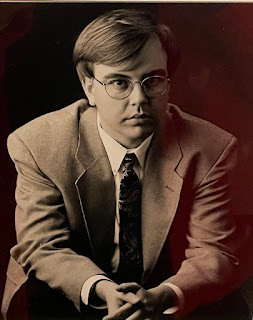
Phillip Kelly

Please say hello to Phillip Kelly, whose review of The 39 Steps will grace these pages shortly.

I met Phillip at Write Act Rep, where we were both members.  I was struck by his talent and commitment as an actor.  Backstage, we conversed frequently about live entertainment and small theatre in particular.  From these conversations arose a desire to strike out and form our own theatre company, which we did in 2009 with a small group of friends.  For two and a half years, he was my Artistic Director at Theatre Unleashed, and we endeavored to put our money (and time and effort) where our mouths were.  We had far more successes than failures at TU, and I'm proud of what we started.

Outside of TU we developed an idiosyncratic comedy act, Mr. Snapper & Mr. Buddy, performing in burlesque shows, variety shows, and the occasional birthday party.  Currently Phillip is producing a new sketch show under the Die Grüppe banner he created at TU (a show I wrote for and perform in) and co-hosts the Advice to the Players podcast with Shakespearean savant Jonathan Redding.

Phillip is a good friend, a trusted partner, and an artist whose opinion I greatly value.  I hope you will enjoy his insight as much as I do.

Friday, January 20, 2012

COME TO OPENING NIGHT


I've been promoting that sketch show I'm in on Facebook, and something occurred to me:  For any show, you want friends and family to come to the first couple of nights.  Sure, it's great to see friendly faces in the audience whenever.  But in order to harness the potential for word-of-mouth, you need to have those friendly faces and their friendly mouths in early enough that they'll have time to promote the show.

Asking anyone to promote something sight unseen is ridiculous.  You want your friends and family to actually see the thing they will be promoting.  First, they can determine whether or not they should promote it -- Die Grüppe's show is beyond risque in places and not everyone is going to feel comfortable posting the name of the show, let alone encouraging people they know to go see it.  Second, the experience of the show is what will create "passionate evangelists."  After I saw Re-Animator: The Musical, I wouldn't shut-up about it.  Ask anyone.  Before I saw the show it was, "Yeah, I'd like to see that."  A virus won't spread unless a person is infected, and you infect people with the actual performance, not just the promise.

Why should they come as early in the run as possible?  Word-of-mouth needs time to spread.  You want your biggest supporters to have as much time as possible to get the word out!


I'm in this show and it opens tonight.  Please come see the show!  I hope you enjoy it, and if you do I hope you'll tell a friend.

Thursday, January 19, 2012

One-Person Shows Suck


Do I have your attention? Good.

Almost a year ago, I ran across an interesting idea that I hadn't seen tackled in a theatrical format (although it is arguably theatrical in it's own right), the presentation format known as PechaKucha.
PechaKucha Night was devised in Tokyo in February 2003 as an event for young designers to meet, network, and show their work in public.

It has turned into a massive celebration, with events happening in hundreds of cities around the world, inspiring creatives worldwide. Drawing its name from the Japanese term for the sound of "chit chat", it rests on a presentation format that is based on a simple idea [...]
"Chit chat."  Nice.  I read about this and shot an email to Phillip Kelly, pitching the idea of "PechaKucha Theatre."  Well, we haven't done anything with the idea, so I'm throwing it out there.
PechaKucha 20x20 is a simple presentation format where you show 20 images, each for 20 seconds. The images forward automatically and you talk along to the images.
6 1/2 minute long, one-person shows with accompanying slides.
03. Why invent this format ?
Because architects talk too much! Give a microphone and some images to an architect - or most creative people for that matter - and they'll go on forever! Give powerpoint to anyone else and they have the same problem.
One-person shows go on too long, too.  Limit a performer to the most important 6 1/2 minutes of their life, and now we're talking.

The PechaKucha format could be an interesting way for production teams in a theatre company to pitch their proposals for the new season.  The Artistic Director of a theatre company could come out and do a little 6 1/2 minute dog and pony show about upcoming productions.  You could put an interesting and new spin on the shopworn "24 Hour Play" concept.  It could be used for playwrights in developing their work.  Theatre companies could present themselves or their seasons at a special PechaKucha session at the Hollywood Fringe Festival.

Or you could do an evening of incredibly personal, incredibly riveting one-person shows.  Personal, because it is storytelling at its most basic.  Riveting, because there is a ticking clock.
DISCLAIMER

Cartoon by Hugh McCleod.  If you don't follow him, subscribe to his daily email, etc. WTF is your problem, exactly?

I write a lot of things on this blog.  Every now and then I get the feeling I should remind my readers--and myself--of one very important thing:

I don't know anything.  Yeah, I've done some stuff.  I've written, directed, and produced.  I've seen a lot, read even more, and have an annoyingly high opinion of my ability to forecast eventualities.  But at the end of the day, I'm just guessing, just opining.  If you don't like what I have to say, rest assured I've been known to hold two contrary opinions at the same time and/or change my mind when new facts reveal themselves.  "Why, sometimes I've believed as many as six impossible things before breakfast."

I try to stay open-minded and curious, even when I come off as stubborn and argumentative.  Sometimes argument is my way of sorting out what I really believe.  Most of the time, probably.

Often enough, I am wrong.  So please disagree with me, but please don't think I don't care deeply about the subjects I address.

And so I leave you with a quote from Hugh McCleod, author of How to Be Creative:
It is so easy in business to lose your desire to learn and grow. One thing we see with successful creators in business, arts, culture. It doesn’t matter the area, is a desire… need… drive… to stay curious.

They ask questions, probe. Always looking to connect unrelated things to make something better, smarter.
Ask questions, stay curious, and don't ever let up on yourself.

Tuesday, January 17, 2012

A Synergy of Story and Storyteller

Frans Hals, Jester with a Lute

One of my favorite screenwriting bloggers, Scott Myers is writing a series on the famous "Katzenberg Memo," now 21 years-old this month.  (Read the entire memo along with some history here.) Today he tackles the section entitled "Stories That Make Us Care."  Writes Katzenberg:
It is the story that people remember. It is the story that gives the movie business its extraordinary power to impact the world.

Part of what makes a story work is mystical. Its originality, its theme, its characters, its dialogue — all these are undefinable ingredients that contribute to the alchemy of a successful story.

But, given this, there are still some overall guidelines of key importance in telling a good story. Most important of these is the need to create one or more central characters who confront something elemental about themselves by the end of the film. This sounds much more cerebral than it is.
As previously opined on this here blog, I believe that in small theatre the personality of the storyteller is just as important as the story being told.

Which leads me to a new thought:  Small theatre is an extension of the bardic tradition:
More influential than even the poetry, however, were the great storytellers and musicians that passed on legends and histories from tribe to tribe. Enigmatic entertainers, these sages communicated carefully constructed tales through lyrics and rhyme without cultural prejudice or politics. Wearing the colors of all lands, but under the thumb of none, these men of strong voice and heart became known as the bards.
Epic poetry can't recite itself.

It raises some interesting thoughts and possible directions.  It coincides perfectly with the idea of bespoke theatre and a rebellion against assembly-line theatre.  It hints at a way to create a true sense of community in the theatre without resorting to shallow antics.  I need to stew on this a bit more ...

Remembering Werner and Bob

One of the beautiful things about theater is the relationships you form.  In some cases, those relationships last a lifetime. I'm marrie...