Los Angeles actors are spoiled by film and television. Most of their auditions are for film and television so they learn to use subtlety, to speak with their "inside voices," to keep things small and realistic. When I first moved to Los Angeles, I had to get into this habit since I came from a strong theatre background. I had to pull back and make things very real and believable. Of course, I've done it so long that I used the same style for my last theatrical audition. I didn't vary my vocal volume for the size of the space and I kept things so small they might not have communicated to the back row. I'm glad I wasn't cast so I could learn that lesson.
I've seen a few plays recently and I've seen a few actors who seemed more like they were performing in film than in theatre. They gave these beautiful, low-key performances which can totally work with the right material and an intimate black box theatre. The problem was that they were in very presentational productions. They were hard for me to hear at times. They seemed like they were out of place in the world of the play. They were as quiet and subtle as I was in that audition.
So how do we fix L.A. actors for theatre? How do I get my groove back so I can nail the next theatre audition? Here's my personal strategy:
1. Read more plays.
2. Decide whether each piece is presentational, representational, or on the grayscale in between the two.
3. Assess the performance venue and/or audition space.
4. Use my Arthur Lessac training to fill the space with my voice.
5. Be as big or as small as necessary to bring the character to life within the realm of the play.
6. Accept my bouquets of flowers at the end.
Thursday, November 09, 2006


Monday, October 30, 2006
Brevity of Characters
How many characters should there be in a play?
Oleanna has two players - professor and student. The play is very cat and mouse, and any additional players would distract from what's going on.
The Road to Nirvana has the two filmmakers, a superfluous wife, and Madonna. I think there's another character in there somewhere, but I can't remember who he was exactly. This play is also very cat and mouse. If you ask me, it has three too many characters.
The point is, if you're going to take up an actor's time (and in L.A., that's a big deal) at least give them something worth doing! Forgettable, thankless roles wind up being played by members of the crew, when the actors originally cast get bored and go off chasing national commercials and soap opera auditions. NO role should be forgettable and thankless. That old adadge "there are no small roles, only small actors" is complete nonsense, and we all know it. Some roles just absolutely suck, and are the result of lazy playwriting.
Look, if the character exists only to deliver a tray of cookies, cut him! Or give him a poignant and touching monologue! But don't expect an actor to jump through the hoops of the audition process and show up for every rehearsal just to perform Larry the Butler (for free.)
More about this later ...
Saturday, October 21, 2006
The "Have to Have" Rut
A kid I once knew got a job and was all jazzed up about saving his money to buy some ridiculous thing that only a kid could want. He asked me "can you take me to a store where I can buy a piggy bank?" I asked him why he wanted to spend the money he had earned on a piggy bank, rather than saving it for his dream toy. He replied "I have to have a piggy bank so I can save my money!"
I have avoided writing because I had to do research first, or I didn't have access to a computer, or the computer I had access to only had Lotus and have to have Word!
Here's where I would typically trot out a long anecdote about how J.K. Rowling writes long hand, or how difficult it was for Shakespeare to pen his five-act epics on crappy parchment with crappy quill feathers by the crappy light of a crappy candle.
Instead, let me offer a practical piece of advice for turning the "have to have" rut around, and getting something done: Assess what you do have. See what can be done with that.
The thing that always draws me back to the theatre is the "make-do" aspect of the art. I like solving problems and getting all MacGyver. It's all about getting by on what you got. In this world of plenty that we live in now, it's easy to get accustumed to always getting exactly what you want when you want it. That's cool ... but not getting what you want should never prevent an artist from creating.
Take what ever it is you're lacking and use that to your advantage. Don't have access to a computer? Pull your play in a pulp fiction/noir-ish direction, and hammer the thing out on that manual typewriter your parents keep in the garage. Maybe seeing your words spill out across a slice of onion paper coiled around the platen of a monstrous old Royal will inspire you to melodramatic heights not reached since the days of Sam Spade.
Why not write the thing in crayon on butcher paper? Who cares? Just write. If someone says "hey, why is this play in crayon on butcher paper?" Tell them "you'll have to read it to find out."
Need to do research first? Go to the library. Or here's a thought: write something that doesn't require research. Or make up the research. I'm picking away at "The Worst Play Ever Written [working title]" that makes a big point of made up research.
Don't get discouraged, just put one word after the next. That's more than most folks ever manage to do!
Wednesday, October 11, 2006
Non-Attachment
To my knowledge, the Buddha was not a playwright. He did, however, pass along a bit of wisdom that serves as priceless advice to even the most irreligious of us who dare create art. This bit of wisdom is at the core of Buddhist philosophy:
Attachment leads to suffering.Behold a frightening picture:
Practice non-attachment.
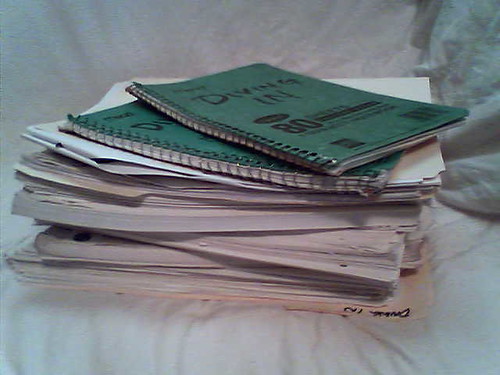
This is the play that would not die. It's my award-winning play Diving In after nearly endless tinkering, attempts at expansion, adaption to the big screen, separation into a three-play cycle, etc. It became a leviathan; a monster that haunted my dreams, kept me up late at night and distracted me for days on end. How many years did I spend beating this poor play to death? I hate to think on it.
One day, sick with the grief of it, I packed the whole damn thing up in a box and put it in storage. No longer attached, I was able to refocus my creative energies elsewhere and on other projects.
There is no shortage of ideas. Just when you think they thought of it all, some jackass in the middle of nowhere surprises us all. Getting all hung up on "that one really good idea" is crazy! And believe me, I know whereof I speak. My attention became so focused on Diving In it was all I could think about. Every conversation I had, article I read, food I ate -- everything -- was related back to Diving In. Being fixated thusly, I wasn't able to fully formulate new ideas or follow new creative impulses. I was stuck! Finally I pulled myself out of it, and there was this huge rush of ideas. I finished a children's book, wrote another play, etc.
You have to know when to say when and have the courage to throw out the baby with the bath water if need be. This isn't an excuse for self-destructive behavior or nihilism. It means recognizing when you've gotten about as far as anyone could possibly expect, and shifting gears. Hiking down a different trail. Whistling a new tune.
Another story: A friend of mine in high school was really into miniature role playing games. He had hundreds of these beautifully detailed figures that he had delicately painted over hundreds of hours. One day his house caught fire and the whole collection -- all that work and investment -- went up in smoke. I felt sick for him. I saw him a few days after I had heard the news and offered my deep condolences.
He shook his head at me. "Are you kidding? I'm relieved!"
He graduated highschool, served a stint in the Army, and some years later took up his hobby again, totally out performing himself in terms of quantity and quality.
Out of the blue a few months ago, it occurred to me that the thing I liked originally about Diving In was the simplicity of the play: A sole actress sits on a window ledge, above the audience and tells them her story. At the end of the play, she jumps off of the ledge and into a blackout (and implicitly, to her death.) I dusted off what was left of the mangled, battered original draft and started putting the pieces back together. It's basically a typist's job now, transcribing the bits and pieces of the thing into a whole again. Any obsession I had about the play has faded away.
Who says you should suffer for you art?
Sunday, September 24, 2006
Unpacking a Monologue
Here is a neat trick!
Every now and then actors have to go fishing for a monologue to perform, for auditions or acting class or what have you. This can lead to a funny sort of desperation. There's not a whole lot of really good monologues to be found in plays, and the ones that do exist tend to be way over done (if I ever here that stupid "to the moon and back again" speech, I'll just go nuts!) Eventually the actor starts eyeballing dialogue that is almost a monologue. The actor takes all the lines of Character #1, omits the lines of Character #2, fudges a few words to cover any awkward, jarring transitions in the resulting monologue and WHAMMO! Instant monologue.
Well, you can do the exact opposite as a playwright. Start with a good monologue and turn it into dialogue!
When I've done this, it's been for the very good reason that theatre can easily become static: talking heads, arbitrary blocking, and a whole lot of nothing going on on stage. To an audience inundated with television and film, sitting in a cold dark room listening to Joe Actor ramble on about the time he saw his dad shoot the horses (or whatever) can be interminable! Long monologues can be as difficult to perform as they are to watch.
The push and pull of conversation can turn a one-sided dull-fest into dynamic, engaging story-telling. At least, that's my theory. Let me put my own neck on the chopping block, and we'll see if my theory is born out in fact. Here's a rough draft of Melanie's confession from my play Torrid Affaire:
(You may note that I made some other edits in Melanie's speech. There comes a point where I go through a draft of the script and start distilling things down. "Peoria, Chicago, Waukeegan, Milwaukee; up to Canada and back" becomes "Illinois, Wisconsin, up to Canada and back." This is difficult for me to do, but I'm getting better at it.)
The thing to do when unpacking a monologue is to find points where you can insert prompts from the other characters: Questions, acknowledgements, comments, whatever. They just have to be sequitur. In other words, they can't be random or distracting. They must contribute to the story continuing on. These prompts can sometimes be taken from the monologue itself.
In monologue, Sally says "Five years ago I divorced my husband and ran away with a circus midget named arthur."
The dialogue goes like this:
I know this seems pretty cheesey, but it works!
Every now and then actors have to go fishing for a monologue to perform, for auditions or acting class or what have you. This can lead to a funny sort of desperation. There's not a whole lot of really good monologues to be found in plays, and the ones that do exist tend to be way over done (if I ever here that stupid "to the moon and back again" speech, I'll just go nuts!) Eventually the actor starts eyeballing dialogue that is almost a monologue. The actor takes all the lines of Character #1, omits the lines of Character #2, fudges a few words to cover any awkward, jarring transitions in the resulting monologue and WHAMMO! Instant monologue.
Well, you can do the exact opposite as a playwright. Start with a good monologue and turn it into dialogue!
When I've done this, it's been for the very good reason that theatre can easily become static: talking heads, arbitrary blocking, and a whole lot of nothing going on on stage. To an audience inundated with television and film, sitting in a cold dark room listening to Joe Actor ramble on about the time he saw his dad shoot the horses (or whatever) can be interminable! Long monologues can be as difficult to perform as they are to watch.
The push and pull of conversation can turn a one-sided dull-fest into dynamic, engaging story-telling. At least, that's my theory. Let me put my own neck on the chopping block, and we'll see if my theory is born out in fact. Here's a rough draft of Melanie's confession from my play Torrid Affaire:
MELANIE: Nathan and I want different things. (pause) That's bullshit. Like saying "creative differences." We spent so much time on the road, playing shitholes. Shitholes for a cut of the door and the occasional free drink. It got to the point where I had to drive the van, because Nathan and the guys were so fucked-up. I had to stay sober because no one else would. Yeah, I know. Wah. Poor Melanie. But believe me ... I was holding that band together all through Peoria, Chicago, Waukeegan, Milwaukee; up to Canada and back. I was the den mother while my boyfriend and my bandmates lived their mockery of a rock and roll lifestyle for nine months.
This goes on for a full page. Yikes!
Now here's the version in the final script, with sequitur interjections by the other characters:
MELANIE: I’m glad never got married.
MOLLY: What happened?
MELANIE: Nathan and I want different things. (pause) That’s bullshit.
Like saying “creative differences.”
MOLLY: You had a band together. You
were real good.
MELANIE: We spent so much time on the road, playing shitholes. For a cut of the door and the occasional free drink. I had to stay sober because no one else would. Yeah I know. Wah. Poor Melanie. But believe me . . . I was holding that band together all through Illinois, Wisconsin, up to Canada and back. I was the den mother while my boyfriend and my bandmates lived their mockery of a rock and roll lifestyle for nine months.
CHARLENE: Unbelievable.
The thing to do when unpacking a monologue is to find points where you can insert prompts from the other characters: Questions, acknowledgements, comments, whatever. They just have to be sequitur. In other words, they can't be random or distracting. They must contribute to the story continuing on. These prompts can sometimes be taken from the monologue itself.
In monologue, Sally says "Five years ago I divorced my husband and ran away with a circus midget named arthur."
The dialogue goes like this:
SALLY: Five years ago ...BARBARA: ... You divorced Dan.SALLY: Yeah.BARBARA: And you ran away with ... what was that circus midget's name?Sally: Arthur.
Thursday, September 21, 2006
Coming Attractions
I have a few entries to wrap up and post here, all relating to my own theories on playwriting. I will deal with plotting, practical concerns, and something I like to call "dialogueing."
I discovered the word "metatheatre" today. It's funny how you can formulate your own ideas and stir them around in the ol' mental cauldron and one day you find out there are others who have been working from the same spellbook -- and these others are much further along in their workings. I Googled the term "metatheatre" after reflecting on some of my pet theories and ideas regarding interactive theatre and how the prefix "meta-" added to the word "theatre" would describe what I was envisioning. Lo and behold, there are many who have gone before.
Expect some pontificating on the subject of metatheatre in the near future.
Saturday, September 16, 2006
Building a Mailing List
It's been a little while since I've updated this blog. I've been very self-involved, working on my own actor and dancer stuff.
I knew that emails and Evites weren't sufficient promotion for our events. I knew that industry postcards were a step in the right direction, but we still weren't getting the attendance we wanted. It is to that end that I set out to collect mailing addresses from all the people I did plays with over the past year. I don't recall whether or not I hit up the filmmakers and cast from short films for their addys. I figure I can build my own mailing list and postcard them so they have a physical reminder of our events instead of a notice that hovers around in cyberspace.
Here's what's funny about this project: different people have different lags in their communication. I asked for mailing addresses nearly one month ago. I got a chunk the first week and they tapered off after that. I did get another one three days ago, even though I sent out the notice a month ago. I'm sure I'll receive addresses here and there for a while. If some of these people are so busy that it takes them a month to get back to my email about a mailing addy, how long did it take them to get around to reading my show emails?
I'm not all finger-pointy here. I'm also a guilty dog. I read an email from a Las Vegas friend a little over a week ago. She said she was coming to town for some number of days and wanted to get together with friends in the area. I didn't write anything down from the email so I still haven't contacted her and I have no idea when she's leaving. That information is still in cyberspace.
I've been told by my dance teachers that I'm doing two performances in December. I'm performing belly dance with the rest of my class at a restaurant in Hollywood at the beginning of that month, and I'm pole dancing with my other classmates later in the month in West Hollywood. My plan is to shoot special postcard pics for the pole event (since I'm a better pole dancer than belly dancer) and send out a couple mailings of those before that event. I'll probably tack a blurb on the front or back of the postcard that I'm belly dancing elsewhere at another time. I'll still use the emails and Evites, but we'll see how this affects the attendance. Then I can apply it to Sonny marketing when we get there.
Subscribe to:
Posts (Atom)
Remembering Werner and Bob
One of the beautiful things about theater is the relationships you form. In some cases, those relationships last a lifetime. I'm marrie...
-
 Bas-relief of a scene from a Roman Satyr Play . ( CC BY 2.0 ) ForsterFoto, licensed under Attribution License. I've been thinking ...
-
 One of the beautiful things about theater is the relationships you form. In some cases, those relationships last a lifetime. I'm marrie...
-
 [NOTE: This review was originally published at Stage Happenings .] Liz Fenning as Heather and Alana Dietz as Charlotte. review by...