Monday, December 18, 2006

Theatre of the Occult

In my online travels, I run across many a strange and exotic idea. Most of the time it's part of a greater body of research; I will be "infogorging" on a particular subject that takes a wild tangent. One such tangent led me to "Pop Occulture" the blog of occult investigator Tim Boucher.

[Editor note: Tim Boucher's website is now defunct and the URL takes you to a site that hosts malware. we had to break the links to republish this piece. We found a snapshot of Tim's blog on The Wayback Machine, in case you would like to read the quote in context.]

Not too long ago Tim blogged on the subject of "The Metaphysics of Media", regarding motion pictures in particular. He states:
Applying that to the matter at hand, we could think of a movie as being a complex set of events, out of which certain events are selected to be filmed. Those events which end up on film are then collected together, edited down and arranged in a linear sequence. The result is what we call a movie or film.

The trick lies in that this movie is composed of selected and arranged events (the "Original Events" - OE), but that the showing of viewing of that movie is in itself an event as well (a "New Event" - NE). In economic terms, we might say that the more people who see this movie, the more "real" the New Event created by the movie becomes. It becomes a shared reference point for masses of people and is added to the cultural lexicon. But if no one watches the movie, it is considered a "flop."
I believe that this could be restated for live theatre.

The word "occult" comes from the Latin occultus meaning clandestine, hidden, or secret. The majority of what we actually do in theatre is hidden from the audience. The audience isn't privvy to the audition process, rehearsals, design work, etc. They see the resulting synergy of all those "Original Events" manifest in the moment, participating with their attention and "suspension of disbelief." In theatre, as in engineering, the whole is greater than the sum of the parts. As a result, theatre can be a transcendent experience. I have had glimpses of this in my short career. I think we all have.

This sort of thing isn't typically considered very seriously when staging a show. Yet I wonder what would occur if we practiced theatre with transcendence as our goal.

Would Bacchus himself show up and demand an aisle seat?

Friday, December 08, 2006

PLOTTING

"Begin at the beginning," the King said gravely, "and go on till you come to the end: then stop."
-- Alice's Adventures in Wonderland

"Go that way really fast. If something gets in your way, turn."
-- Advice to Lane Meyer(John Cusack)
from Charles De Mar (Curtis Armstrong)
and Monique Junet (Diane Franklin)
in the movie Better Off Dead
The problem with unlimited freedom is inertia. If you can go in any direction at any speed, off into eternity, you might as well stay still. Structure is important if only to tell you where to go and when to stop. All the detail work, the fancy character choices, the witty dialogue -- that's the freedom that exists within the carefully determined boundaries of plot. In other words, a carefully thought out and planned plot allows for creativity and imagination to flow.

There comes a point when I've been stirring around the cauldron of ideas that the play starts boiling over. I'm ready to write. At this stage in the process, It's time to plot out the play. The way I learned to do it is with the old standard "plot card" technique. Any decent book on playwriting or screenwriting will tell you all about this, but here's my take.
  • Get a bunch of lined 3 x 5 note cards
  • Write the title (working or otherwise) on a card. (If you are planning on major act divisions [acts, scenes, vignettes, etc.], make a "title" card for each major division ["Act I"])
  • Put each of your major plot points on a card (Romeo meets Juliet, Romeo kills Tybalt, Juliet fakes her death, etc.)
  • Make "Introduction of [character name]" cards for each of your characters.
  • Let your imagination go wild: put scene ideas, bits and pieces of dialogue, etc. on note cards.
  • Now lay out your cards from beginning to end, roughly setting out when each event should occur. If you have cards that don't quite fit yet, set them aside.
  • Go through and create gaps in your layout where obvious gaps in continuity exist (missing transitions, needed plot points, etc.)
  • Fill in the gaps.
  • Go through and read the cards, paying close attention to flow.
  • Rearrange cards, take some out, write new ones. Tinker with it. Roll up your sleeves and get your hands dirty!
  • Put the cards in a neat, chronological stack. Go through them one at a time and write your play!
Note - one card is roughly equivalent to 2 pages or less of script. Roughly.

This is a very structured approach to plotting, and I know first hand that sometimes it feels better to just let the words flow. Sometimes the muse won't wait for you to plot things out. Well, fine. Just write. Jump continuity, write scene fragments -- have a ball! Later on, when you're stuck and have no notion of what to do next, transfer brief descriptions of your fragments onto notecards, and plot out the rest of the play.

The word "plot" literally means "piece of ground". I like to think of the plot as the map of the play. It'll tell you how to get from point "a" to point "b" but it's still up to you to detour around a bit and see the sights. After you've bought the souvenir spoon and seen the world's largest ball of twine, the map will keep you heading towards your destination: a finished play.

Monday, December 04, 2006

DOVER KIDS

Once upon a time Pamela and I took a one-person show around to elementary schools in Arkansas. The play was "Einstein's Quest" written by academic hermit and noted playwright Allen Partridge. Al wrote the thing so it could be performed by a guy or a gal, and in the early days of doing this, we took turns performing.

"Einstein's Quest" is a high-energy, interactive play that teaches creative problem solving to children from kindergarten to eighth grade. The emphasis here is on "interactive". The second half of the show does not work unless the kids are actively communicating with the performer.

Arkansas has many small schools scattered throughout the rural areas. A performer with good scheduling skills and enough gumption can hit up to three different locations in a day. When we first started doing "EQ", we were working for Al. (He would later turn the reigns of the company over to us before falling off the face of the earth.) Our second time out on the road, things were humming along beautifully. Pamela was up first and had a great audience first thing in the morning. I went second, and knocked 'em dead. And so we arrived at our third and final venue for the day in Dover, Arkansas.

Before Pamela took the stage, the principal addressed the assembled kids. Here's what he said, from memory:

"Okay. You remember the rules? We brought these kind people here to put on a play for you. I want you to keep your mouths closed and your eyes open. Sit on your hands. If you make any noise, or have any fun whatsoever, I will have the orcs dragged you down to the dungeon and there we will break you on the wheel!"

Well, it was something like that. The kids were absolutely terrified. When he introduced Pamela, you could hear a pin drop. It was unnatural to have that many elementary kids that still and quiet. And it would've meant theatrical death for that performance of "EQ".

Pamela (and this is one of the reasons I absolutely adore her) completely crushed the iron strangle hold the principal had on the kids. She did it with the old "hello come-back" technique:

PERFORMER
Hello.

AUDIENCE (unsure, nervous)
Hello.

The Performer paces the stage, shakes her head, sighs.


PERFORMER
Hello!

AUDIENCE (warming up)
Hello!

Performer nods her head. "Not bad." She steps back, and jumps forward:

PERFORMER
HELLO!!!

AUDIENCE (fully engaged)
HELLO!!!


Usually, that's all it take s to get the audience's attention fully focused on the performance. As I recall it, it took more than three "Hellos" to get the audience warmed up. In actuality, the audience needed to feel safe. Here were kids who were no doubt whipped for coloring outside the lines. Pamela, in shouting "HELLOOOOOO!!!" at them demonstrated a boldness and power that they had probably never seen. It made them feel strong, and so they responded in kind by the end of the "hello come-back" routine: "HELLOOOOOO!!!"

Thus unbridled by the wicked tyranny of the despot principal, the children became the biggest bunch of rowdy, uncontrollable ape-children I have ever witnessed. Pamela had to contend with a ROAR of laughing, talking, shouting, singing ... children dancing around, doing jumping jacks, breakdancing ... it became mass hysteria. Pamela soldiered on, keeping the reigns loose in her hands and riding those kids over the finish line and into the most heartfelt standing ovation I daresay has ever manifested in Dover, Arkansas.

And so "Dover Kids" entered the Moore lexicon. "Dover Kids" signifies a group of repressed, suppressed, and oppressed people who, upon finding a safe environment to "be themselves," go completely nuts with all the freedom. You see this a lot in acting classes. In an acting class, you can stretch out and do things that you can't do "in the industry" like wear an adult diaper on stage, or perform oral sex on your scene partner. (I wish those were made up examples. I really do.)

"Dover Kids" suffer from a lack of self-discipline in an environment with little to no rules. They wind up pissing in the pool and ruining the fun for everyone. But you can't really hold it against them. They've grown up in an environment where it wasn't safe to express themselves at all, so there's a lot of pent-up energy that has to get out.

So that's what is meant when one of us refers to "Dover Kids".

Thursday, November 09, 2006

Los Angeles actors are spoiled by film and television. Most of their auditions are for film and television so they learn to use subtlety, to speak with their "inside voices," to keep things small and realistic. When I first moved to Los Angeles, I had to get into this habit since I came from a strong theatre background. I had to pull back and make things very real and believable. Of course, I've done it so long that I used the same style for my last theatrical audition. I didn't vary my vocal volume for the size of the space and I kept things so small they might not have communicated to the back row. I'm glad I wasn't cast so I could learn that lesson.

I've seen a few plays recently and I've seen a few actors who seemed more like they were performing in film than in theatre. They gave these beautiful, low-key performances which can totally work with the right material and an intimate black box theatre. The problem was that they were in very presentational productions. They were hard for me to hear at times. They seemed like they were out of place in the world of the play. They were as quiet and subtle as I was in that audition.

So how do we fix L.A. actors for theatre? How do I get my groove back so I can nail the next theatre audition? Here's my personal strategy:

1. Read more plays.
2. Decide whether each piece is presentational, representational, or on the grayscale in between the two.
3. Assess the performance venue and/or audition space.
4. Use my Arthur Lessac training to fill the space with my voice.
5. Be as big or as small as necessary to bring the character to life within the realm of the play.
6. Accept my bouquets of flowers at the end.

Monday, October 30, 2006

Brevity of Characters

How many characters should there be in a play?

Oleanna has two players - professor and student. The play is very cat and mouse, and any additional players would distract from what's going on.

The Road to Nirvana has the two filmmakers, a superfluous wife, and Madonna. I think there's another character in there somewhere, but I can't remember who he was exactly. This play is also very cat and mouse. If you ask me, it has three too many characters.

The point is, if you're going to take up an actor's time (and in L.A., that's a big deal) at least give them something worth doing! Forgettable, thankless roles wind up being played by members of the crew, when the actors originally cast get bored and go off chasing national commercials and soap opera auditions. NO role should be forgettable and thankless. That old adadge "there are no small roles, only small actors" is complete nonsense, and we all know it. Some roles just absolutely suck, and are the result of lazy playwriting.

Look, if the character exists only to deliver a tray of cookies, cut him! Or give him a poignant and touching monologue! But don't expect an actor to jump through the hoops of the audition process and show up for every rehearsal just to perform Larry the Butler (for free.)

More about this later ...

Saturday, October 21, 2006

The "Have to Have" Rut

A kid I once knew got a job and was all jazzed up about saving his money to buy some ridiculous thing that only a kid could want. He asked me "can you take me to a store where I can buy a piggy bank?" I asked him why he wanted to spend the money he had earned on a piggy bank, rather than saving it for his dream toy. He replied "I have to have a piggy bank so I can save my money!"

I have avoided writing because I had to do research first, or I didn't have access to a computer, or the computer I had access to only had Lotus and have to have Word!

Here's where I would typically trot out a long anecdote about how J.K. Rowling writes long hand, or how difficult it was for Shakespeare to pen his five-act epics on crappy parchment with crappy quill feathers by the crappy light of a crappy candle.

Instead, let me offer a practical piece of advice for turning the "have to have" rut around, and getting something done: Assess what you do have. See what can be done with that.

The thing that always draws me back to the theatre is the "make-do" aspect of the art. I like solving problems and getting all MacGyver. It's all about getting by on what you got. In this world of plenty that we live in now, it's easy to get accustumed to always getting exactly what you want when you want it. That's cool ... but not getting what you want should never prevent an artist from creating.

Take what ever it is you're lacking and use that to your advantage. Don't have access to a computer? Pull your play in a pulp fiction/noir-ish direction, and hammer the thing out on that manual typewriter your parents keep in the garage. Maybe seeing your words spill out across a slice of onion paper coiled around the platen of a monstrous old Royal will inspire you to melodramatic heights not reached since the days of Sam Spade.

Why not write the thing in crayon on butcher paper? Who cares? Just write. If someone says "hey, why is this play in crayon on butcher paper?" Tell them "you'll have to read it to find out."

Need to do research first? Go to the library. Or here's a thought: write something that doesn't require research. Or make up the research. I'm picking away at "The Worst Play Ever Written [working title]" that makes a big point of made up research.

Don't get discouraged, just put one word after the next. That's more than most folks ever manage to do!

Wednesday, October 11, 2006

Non-Attachment


To my knowledge, the Buddha was not a playwright. He did, however, pass along a bit of wisdom that serves as priceless advice to even the most irreligious of us who dare create art. This bit of wisdom is at the core of Buddhist philosophy:

Attachment leads to suffering.
Practice non-attachment.
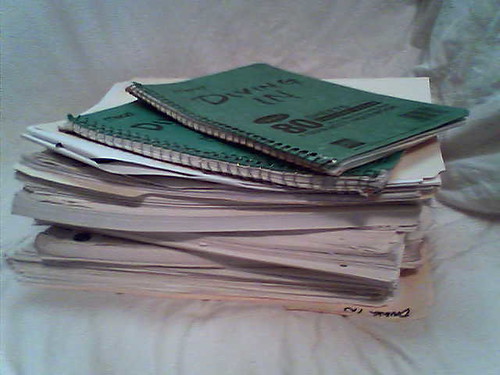
Behold a frightening picture:


This is the play that would not die. It's my award-winning play Diving In after nearly endless tinkering, attempts at expansion, adaption to the big screen, separation into a three-play cycle, etc. It became a leviathan; a monster that haunted my dreams, kept me up late at night and distracted me for days on end. How many years did I spend beating this poor play to death? I hate to think on it.

One day, sick with the grief of it, I packed the whole damn thing up in a box and put it in storage. No longer attached, I was able to refocus my creative energies elsewhere and on other projects.

There is no shortage of ideas. Just when you think they thought of it all, some jackass in the middle of nowhere surprises us all. Getting all hung up on "that one really good idea" is crazy! And believe me, I know whereof I speak. My attention became so focused on Diving In it was all I could think about. Every conversation I had, article I read, food I ate -- everything -- was related back to Diving In. Being fixated thusly, I wasn't able to fully formulate new ideas or follow new creative impulses. I was stuck! Finally I pulled myself out of it, and there was this huge rush of ideas. I finished a children's book, wrote another play, etc.

You have to know when to say when and have the courage to throw out the baby with the bath water if need be. This isn't an excuse for self-destructive behavior or nihilism. It means recognizing when you've gotten about as far as anyone could possibly expect, and shifting gears. Hiking down a different trail. Whistling a new tune.

Another story: A friend of mine in high school was really into miniature role playing games. He had hundreds of these beautifully detailed figures that he had delicately painted over hundreds of hours. One day his house caught fire and the whole collection -- all that work and investment -- went up in smoke. I felt sick for him. I saw him a few days after I had heard the news and offered my deep condolences.

He shook his head at me. "Are you kidding? I'm relieved!"

He graduated highschool, served a stint in the Army, and some years later took up his hobby again, totally out performing himself in terms of quantity and quality.

Out of the blue a few months ago, it occurred to me that the thing I liked originally about Diving In was the simplicity of the play: A sole actress sits on a window ledge, above the audience and tells them her story. At the end of the play, she jumps off of the ledge and into a blackout (and implicitly, to her death.) I dusted off what was left of the mangled, battered original draft and started putting the pieces back together. It's basically a typist's job now, transcribing the bits and pieces of the thing into a whole again. Any obsession I had about the play has faded away.

Who says you should suffer for you art?

Remembering Werner and Bob

One of the beautiful things about theater is the relationships you form.  In some cases, those relationships last a lifetime. I'm marrie...