Monday, January 13, 2025

Remembering Werner and Bob

One of the beautiful things about theater is the relationships you form. 

In some cases, those relationships last a lifetime. I'm married to my costar from a community theater production of The Crucible. One of my best friends in the world I met in a high school speech class. 

And then there are the people who make their entrances and exits, as ephemeral as theater itself. Their lives go on, your life goes on, but you may never again share the same breathing space. And yet, given the peculiarities of what we do, we still feel connected by gossamer strings.

For instance, I haven't been in the same room with my fellow Ozarks alum Brian in over a decade, but he's chummy with a whole bunch of folks who were in the theater company I cofounded in North Hollywood. I also know for a fact that the next time I see Brian--and you never know when paths may cross in this crazy world--we will fall into the same rhythms we shared in the Seay Theatre green room. 

It's strange, looking over my friends on Facebook, how many of them I share a single resume line with. A single show. And yet we continue to interact, staying up on each other's lives, celebrating each others successes, mourning each other's losses.

There have been two such losses recently that have made me a bit introspective.

The first is Werner Trieschmann. I knew Werner as a playwright, but he was, of course, so much more. He led Critics Institute at our statewide American College Theater Festival (ACTF), and was the first person outside my circle of friends to read and give notes on my writing. 

"OK, Those are my notes," he wrote. "I hope they have helped you. However, I would remind you that these are just observations. Writers have to write and follow their own wanderlust. This is a unique and interesting work. You have great promise. Write more. Produce it. Send it out."

That meant the world to a 20 year-old living in Clarksville, Arkansas. Especially coming from an Arkansas playwright whose work I idolized. I did write more, I did produce it, and I did send it out. 

The second is Robert Machray Ward. I met Robert through Paul Storiale. Paul was managing The Sherry and Whitmore-Lindley, in addition to writing and producing his own stuff, including his very successful play, The Columbine Project. I was feeling a bit lost, on the cusp of walking away from the theater I started. Paul suggested I get out and get to know the LA theater scene by becoming a reviewer.

I joined Bob's stable of reviewers in 2010, and did indeed get to know the LA theater scene. For the first time in a while, I felt excited by the prospect of live theater, and reviewing shows produced by Sacred Fools, Theater West, Santa Monica Playhouse, and so many others made my decision to leave my own company a whole lot easier.

If you dig deep into the archives of Mad Theatrics (and I don't really recommend doing so) you will see a shift around the time I started reviewing for Bob. My writing shifted away from Jeremiads about how things went wrong at the old company and toward what was going right at under-99 seat theaters across LA.

I owe both Werner and Bob a debt of gratitude. They brought out the best in me, despite our brief encounters.

Wednesday, July 12, 2023

On the Importance of Comparing Notes

My wife and I were briefly involved in a group that has since become rather infamous for institutionalized abuse. It's a pretty sad commentary on the world in which we live that I've just described at least a dozen organizations.

While we were in the group, we never really compared notes. We wanted to think the best of this group that we joined. Although neither one of us suffered the worst abuse that has since been reported, we nevertheless paid witness to petty abuses that stood in stark contrast to the stated aims and goals of the group. What led to our departure from the group was finally, at long last, comparing notes.

Patterns of abuse emerge. "You saw that happen? Well let me tell you about this thing that happened!"

When you hold that stuff in, you can begin to doubt yourself. "Did that really happen?" "Am I overreacting?" "Am I just recontextualizing a memory of something that was benign at the time?"

I've been nursing a grudge for a little over thirteen years. It grew out of another group, one my wife and I started this time, rather than joined. I've come to think of it as "nursing a grudge," I should say. I was frozen out, bullied, yelled at, and ultimately bailed on a group I put a significant amount of sweat equity into. The grudge is completely justified.

But years have passed. An ocean has flown under that particular bridge. And so I came to believe that, to some degree, the grudge was on me. Actually blaming myself for the way I felt.

As it turns out, you can still compare notes a decade later. You can hear about others who have suffered very similar (though not identical) treatment at the hands of a particular person. Someone who bullies, belittles, and bellows. Someone who will smile to your face while assassinating your character behind your back. Someone, it would seem, who may just get his comeuppance.

Sunday, April 03, 2022

Echoing into Nothing


Photo by Marcelo Jaboo
One of the damndest things about theater happens to be its greatest strength: it lives and breathes in the moment. If you weren't there, you missed it. When I think about how many original works have faded back into the shadows, never to be heard of again, it makes my heart hurt. I recall so many nights, sipping cheap wine in storefront lobbies, looking at dusty framed posters of such shows. I have some such posters on my own walls at home (which reminds me, I need to do some dusting.)

To quote the poet, "This isn't meant to last/This is for right now." It's just the nature of the beast, and like I said at the top, it gives live theater its particular strength. Our audiences are present witnesses to the creation of our art. Sure, we meet and rehearse and build sets and hang lights and all of that. But the whole thing doesn't mean anything until at least one warm body watches as it all comes to fruition.

And when it's all over? It's all over. Unless some forward-thinking person took pictures at a rehearsal, or some packrat happened to hold on to a program, there is precious little evidence that anything magical actually happened. We have our memories.

Oh yeah... and we have reviews.

Let's say you see one of those dusty posters. Maybe you recognize an actor's name. Maybe you just like the art. You whip out your mobile device and see what else you can find out about that show. You might find some archive on the theater company's website. But maybe that company went through a nasty divorce with some past members, and petulantly deleted all reference to them. Maybe you find a resume line on an actor's website. Maybe, just maybe you find a review.

I'm somewhat inclined to rev Mad Theatrics back up, if only to keep a running record of productions that won't live past their original run. If only there were more hours in a day.

Sunday, February 21, 2021

This is just to say...


I have changed
the theme
that was on
this weblog

and which
you were probably
annoyed
to look at

You're welcome
this is much better
so dark
and theatrical

Tuesday, August 25, 2020

'Tis Drama Tech*

My wife and I started this blog back in 2006. It was a place for our idle thoughts about theater, and eventually grew into a middling source of reviews and opinions of and about Los Angeles theater.

We effectively killed it off in 2016, around the time we decided to move to Texas. I've posted a couple of times since then, mostly to direct folks to our "new digs" at Wordpress.

I haven't really done anything with the Wordpress site.

Mad Theatrics is staying up as an archive. Mostly for the reviews. Apparently my old design doesn't work on mobile, so I picked a boring design that does. Boy howdy, does the blog look like shit now. Yikes.

 *(an anagram of Mad Theatrics)

Thursday, March 09, 2017

"Acrobats of the Soul": A Revisitation and Review

I recently revisited a book I haven’t read since college, Ron Jenkins’ Acrobats of the Soul: Comedy & Virtuosity in Contemporary American Theatre. It is a time capsule from the late eighties, each chapter sketching a portrait of a variety artist or circus. Performers such as Paul Zaloom, Penn & Teller, Spalding Gray, Avner the Eccentric, and the Flying Karamazov brothers; Circuses ranging from Cirque du Soleil's then-nascent techno rock show to the scrappy one-ring Pickle Family Circus.

When I first read the book, I did so with the wide-eyed wonder of a teenager in Arkansas, amazed that such performers exist. Coming back to it about a quarter of a century later, as someone who follows in the variety arts tradition both as both a solo artist and as one-half of Mr. Snapper & Mr. Buddy, my appreciation for the performers and their acts is much deeper. Jenkins’ book is a great jumping-off point for further discovery, providing descriptions of acts and some script excerpts.

Where it fails for me is in Jenkins’ attempt to politicize the performers and acts. Granted, he doesn’t have to read much into the politically charged work of Zaloom or Gray, but his analysis of Cirque (as a for instance) feels particularly contrived. Jenkins is attempting to make an overarching point about the resurgence of variety artists in the ‘80s as a reaction to Reagan conservatism.

Without a doubt, opposition to the powers-that-be has always been and always will be a powerful motivator for great art. The fact that these same artists continued to thrive through the Clinton years and beyond speaks to a more fundamental quality, something that defies mere politics. And this is the greater lesson I take away from the book now: commitment to one’s craft, and active concern with audience engagement is more lasting than the heat of the political moment.

It speaks to our moment, as well. One of my greatest pet peeves is when performers make a meal out of low-hanging fruit. Going for the obvious gag, playing fan service to an audience who already thinks the way you do. Low-hanging fruit is at best a light snack; a fun size Snicker bar that gives you a burst of endorphins but little actual sustenance. The acts in Jenkins’ book had and have staying power precisely because they provide sustenance.

Off-the-cuff jokes about Reaganomics may have given audiences to The Flying Karamozov Brothers a jolt of delight; the mind-blowing synchronization of various and sundry objects passed between the “brothers” hits on something way deeper. The force of Zaloom’s stage presence, his lateral-thinking satirical observation is more resonant than the party affiliation of whoever is in the White House at the moment.

The lesson I take from Acrobats of the Soul defies the political patina Jenkins washes over everything. Rather, it’s the dialectic between Jenkins’ approach, and the longevity of the performers he profiled that reaches the slightly less wide-eyed adult who read the book most recently. Focus on your act and focus on your audience with fierce dedication.

Saturday, June 11, 2016

"... there of their own accord and acting from their own free will."


"I think of the security of cages. How violence, cruelty, oppression, become a kind of home, a familiar pattern, a cage, in which we know how to operate and define ourselves …"
- Eve Ensler, Insecure at Last

Tuesday, May 03, 2016

Defined Through Its Effect

"Entertainment -- the cause -- is thus inversely defined through its effect: a satisfied and happy psychological state. Yet, somehow, it matters not whether the effect is achieved through active or passive means. Playing the piano can be just as pleasurable as playing the stereo." 
- Harold L. Vogel, Entertainment Industry Economics

Even when viewed through the cold lens of economics, it's about the audience.

Saturday, April 30, 2016

Bring People Joy

"When I’m on stage, I’m trying to do one thing: bring people joy. Just like church does. People don’t go to church to find trouble, they go there to lose it." 
- James Brown

Wednesday, March 30, 2016

Why We Stopped Writing Reviews

Fringe season is upon us, and with it a coming barrage of emails and Twitter messages inviting Mad Theatrics out to review anything and everything. We stopped publishing reviews in 2014 -- hell, we stopped publishing anything in 2015 -- but I still get review invites all the time.

There are no plans to start up the ol' play review grindstone anytime soon, and so I thought I might try to head off some of those emails and messages with this post.

WE DON'T WRITE REVIEWS ANYMORE

So, that's pretty much it.

...

So, uh, thanks for stopping by.

...

Yeah, yeah, I know. Why post something short and simple when I can navel gaze for a few hundred words?

WHY WE STOPPED WRITING REVIEWS

The Visceral Company Broke Me. I became a fan, and had to stop reviewing their shows. At the same time, I had no interest in going to see anything other than the quality of work I had found at Visceral (and Sacred Fools and Rogue Artists Ensemble.) If I'm only willing to review shows that I know I'm inclined to love, I'm no longer a critic. I'm a cheerleader.

It really started with Sacred Fools. They are an extraordinarily good group of people. So good, in fact, that I would like to someday work with them. I can't very well do that if I'm "the enemy." My priorities changed.

On a related note ...

Writing About Other People's Stuff Was Getting In The Way Of Writing My Own Stuff. I was spending too much time consuming, thinking about, and writing about the works of other people.

It was a very worthwhile exercise. When Paul Storiale first suggested that I start writing reviews, he said it would serve the dual purpose of exposing me to more theater in Los Angeles (thus improving my understanding of the scene overall) and would help me hone my story sense as a writer. He was correct on both counts.

I Got Tired Of Adding To The Noise. Seriously. I think there are now more critics than theater companies.

On a related note ...

No One Fucking Cares. No one decides to go to a play based on the opinion of some random anonymous dude on the internet. You decide to go to a play because someone you know is in it. You decide to go because you're on the theater company's mailing list, and you really like the sound of Troilus and Cressida set in 1930's Chicago.

The bulk of our traffic came just after informing a theater company PR person that the review of their show was up. Noting this, we focused on our actual audience: The folks involved in producing the shows we reviewed. Our reviews became more like notes and less like snark. I like to think that some of the people who read our reviews got something out of them, but I'm not fooling myself. The whole reviewer/reviewee relationship is not set up that way.

Most likely, anything good we wrote was taken as a welcome ego stroke, and anything bad was brushed off as "misunderstood intentions" or somesuch. Like the blind prophet Tiresias, I've been on both sides of this situation. I know how it goes.

In Conclusion, we do not write reviews anymore.

Thursday, March 24, 2016

Sympathy for the Divine

"Good bad taste is celebrating something without thinking you’re better than it. You think it’s so amazing, and you could have never even thought it up.
    
"Bad bad taste is condescending, making fun of others.

"So that’s the difference for me: if you’re celebrating something or you’re looking down on something."

- John Waters (source) 

If you've ever seen any video of a live act, you know: You MUST be in the room to really get the full effect. A video may sometimes look pretty, but more often than not it looks horrible. It is impossible to get an accurate video artifact of a live performance unless you're a Martin Scorsese or Jonathan Demme, and even then the level of trickery and control employed is well beyond the means of your average videographer, no matter how dedicated or awesome that videographer may be.

To say something is "lost in translation" when a video or (god help you) photo of an act is chanced upon online is to engage in superlative understatement. You can't judge a book by its cover, and you most certainly can't judge a burlesque act by its fat suit.

Brandy Snifter's Divine act is a loving tribute to everything that Divine and the films of John Waters have come to symbolize. Embracing the outsider, reveling in what "decent" society considers trash.

Brandy doesn't do glib, dilettante work when she takes the stage. She is fully committed to everything she does onstage. She's not playing at Divine, she's playing Divine. Her Divine drag is perfect. She looks like Divine, and she fully owns the persona. Everything is on point, including the overall silhouette.

She's not shaming fat people for being overweight. To say that would be to say she's shaming Divine for being overweight, and of course that is not what Brandy is doing.

And herein lies the controversy. Brandy performs a striptease, down to a "fat suit." On its face, it sounds bad. Still photos and video taken out of context may seem shocking. In context of the act, dismissively calling it a "fat suit" is a pejorative. When Brandy strips down to and out of the fat suit, she's not shedding layers of fat; she's shedding a specific silhouette. She's shedding Divine' s silhouette. She's not shaming fat people for being overweight. To say that would be to say she's shaming Divine for being overweight, and of course that is not what Brandy is doing. Of course it's not.

Brandy is not propping up a caricature as a representation of reality in order to belittle others. Her act is not a metamorphosis of a fat person becoming skinny. In fact-- and this is some deep shit here -- Brandy is revealing something very personal about how she views herself by taking on the mantle of Divine. Brandy is stripping away the externals of Divine to get to the core of Brandy Snifter, as if to say, "This is who I am."

Brandy Snifter's reveal is not a "fat suit." Her reveal is something deeply personal about herself.

It's easy to get tripped up on the external, and that's rather the problem. Getting tripped up on the external is what the "straights" do to the heroes in John Waters movies. Tripping out on the fact that Brandy Snifter strips down to a fat suit is like tripping out that Glenn Milstead didn't really have tits. It misses the point by a mile while simultaneously proving the greater point. It proves the necessity of this kind of an act.

Brandy Snifter's reveal is not a "fat suit." Her reveal is something deeply personal about herself.

Somehow we've gone through a wormhole where we have to remind people that it's okay to be weird and different. We're all weird and different now, all of us, all weird and different just exactly the same as all the other weird and different people. When a person stands up and presents something personal and genuinely outre, what do we do? The same thing society has done to the outre since the beginning of society. Shun. Ostracize. Make them feel lesser-than.

That is the great tragedy in all of the hoopla that has surrounded Brandy's act. The reaction to it, the outrage and subsequent belittling of a performer who is honestly putting herself out there, is exactly the sort of thing that would piss off a person like Divine.

If you are an injured party in all this and feel you have some legitimate claim to feeling offended, that's your prerogative. You are absolutely entitled to your opinions and feelings, and no one can say boo about that. But I would ask that before you go on a wrecking campaign against another person's reputation, at least try to understand where they're coming from.

You may not like the art, but you might just come to respect the artist.

Monday, March 21, 2016

Sink or Swim

"It is unfortunate and unacceptable what vile and lazy do-nothings are given unwarranted credence for mouthing such foul and mean cliches as 'rip-off' and 'sell-out.' They have no understanding of our economy and the time it takes society to go. Confess and shut up! Capitalism good or ill is the river in which we sink or swim. Inspiration has always been born of recombination." 

- Gary Panter, "The ROZZ-TOX Manifesto"

Friday, March 18, 2016

Time To Renew Your Passport

"From the start it has been the theatre's business to entertain people.

"It needs no other passport than fun." 


- Bertolt Brecht, A Little Organum for the Theatre

Monday, November 03, 2014

Curtains

If we shadows have offended,
Think but this, and all is mended,
That you have but slumber'd here
While these visions did appear.
And this weak and idle theme,
No more yielding but a dream,
Gentles, do not reprehend:
If you pardon, we will mend:
And, as I am an honest Puck,
If we have unearned luck
Now to 'scape the serpent's tongue,
We will make amends ere long;
Else the Puck a liar call;
So, good night unto you all.
Give me your hands, if we be friends,
And Robin shall restore amends.
 Good night, folks.

Saturday, September 13, 2014

Should You Insist on Starting a Theater Company ...

Want to start a theater company? Take this advice from someone who has been there:

Don't. Los Angeles, we are told, makes more theater per capita than New York city. There are more theater companies and producers in this town than you probably realize (I'm constantly discovering "new" companies that have been around for years), and many of them are doing astounding work that deserves the hard work and toil you might otherwise spend pushing a boulder up a hill. Date. Be promiscuous with your theater love. Join a half dozen companies (but whatever you do, DON'T PAY DUES.)

Should you insist on starting a theater company, be smart about it -- well, be as smart as you can about it. You've already decided to start a theater company, after all, which is not the smartest first step.

Seth Godin dropped some wisdom on his blog yesterday, in a post titled "The Launch Meeting":
The amateur's launch meeting is fun, brimming with possibility and excitement. Everything is possible. Goals are meant to be exceeded. Not only will the difficult parts go well, but this team, this extraordinary team, will be able to create something magical.

Possibility is in the air, and it would be foolish to do anything but fuel it. After all, you don't get many days as pure as this one. 

I've been there, and it was fun, brimming with possibility and excitement. And that's about it. Oh, raw talent, to be sure, and considerable know-how when it came to producing theater. Were we ever truly on the same page, sharing the same goals and management philosophy for the company? That might have been a better place to begin:
The professional's launch meeting is useful. It takes advantage of the clean sheet of paper to address the difficult issues before egos get in the way. Hard questions get asked, questions like:
  • What are the six things most likely to go wrong?
  • What will lead us to go over budget? Over schedule?
  • How will we communicate with one another when things are going well, and how will we change that pattern when someone in the room (anyone in the room) realizes that something is stuck?
Those three bullet points will save you considerable trouble, if you're starting a new company. As Seth says, you need the amateur's enthusiasm and big think, but you will be lost without a realistic approach. Failing to hammer out such details before you file that fictitious business name will eventually lead to years of not talking to people you once considered cohorts. Again, speaking from experience.

Because the internet is fueled by lists and pictures of cats,

Mad Theatrics Advice For Starting A Theater Company


  • WHY? Ask this question constantly. "Why?" is your friend. I've quoted the passage so much, I should have it programmed as a macro, but here again is Peter Brook from The Empty Space:
There is always a new season in hand and we are too busy to ask the only vital question which measures the whole structure. Why theatre at all? What for? Is it an anachronism, a superannuated oddity, surviving like an old monument or a quaint custom? Why do we applaud, and what? Has the stage a real place in our lives? What function can it have? What could it serve? What could it explore? What are its special properties?
Are you filling a niche? Because if you're not, you're just adding more noise to an already noisy arena. Don't try to be everything to everyone. Find a community and serve it.

(It's a pretty short list, but in my opinion, that's the most relevant thing to address.)

Wednesday, July 02, 2014

Carla Rhodes, Cecil Sinclaire, and Defying Expectations in Art

"I think no matter what happens 
with me in my life ...
Carla Rhodes with Cecil Sinclaire, photo by Hanna Toresson (www.hannatoresson.com)


... I will always be doing 
something artistic."

My comedy partner and I were once paid a tremendous compliment. One night, after hosting a burlesque show in Hollywood, an audience member approached us and said, "I can't believe you guys are real." I took it to mean we were filling a niche, bringing to the stage a fresh take on the (sometimes hackneyed) comedy tropes we exploit.

There is a constant tension between reality and our idealized hopes and dreams. We feel this tension on Christmas Eve, before walking into a new job for the first time, and in the darkened theater. The best variety acts thrive by traversing that tension, manifesting the impossible; by both satisfying the expectations the audience doesn't know it has and defying expectations of what is actually possible.

I can't believe Carla Rhodes is real.

I was hosting the Monday Night Tease the first time I saw Carla and Cecil. I love vent acts, but they are fairly rare. I was anticipating the act, but completely unprepared for it. Carla plays into vent tropes and subverts them. Ventriloquism is a musty, old art form? Well here's a musty, old vent figure named Cecil who exploits and explodes the audience's expectations. Carla bills as the "Rock 'n' Roll Ventriloquist," and it's apt: conceptually, her act is cranked up to 11. And she kills.

Emily Sheskin and Veena Rao have put together a Narratively video about Carla, entitled Secrets of a Die-Hard Ventriloquist. The video is short and sweet, and well worth your time. Click here to go watch it or check it out in the embedded video below.

Carla is based in New York, but she does get out to Los Angeles from time to time. Be sure to like her on Facebook and follow her on Twitter to find out when you can catch her act live.

Wednesday, May 28, 2014

Life's What Happens

I assure you, the rest of the Juana series is coming. I've been a little busy over the past few weeks.


For starters, our 8 year-old dog, The Doodlebug, was diagnosed with anemia some weeks back. She's doing much better now, but the vet bills are stacking up (blood tests, vet visits, prescriptions, etc.) To help cover the expenses, we're making Doodle pillows (pictured above, with The Doodlebug.) The response has been overwhelming, and I've spent a pretty fair chunk of my time slaving over a hot sewing machine.

This experience has inspired some thoughts regarding fundraising and social media, and I will share those in due course.


We paid visit to Hot Springs, Arkansas over the weekend. It was time to see the families and share the stage with the lovely ladies and gallant gents of Foul Play Cabaret. I also spent a chunk of Saturday with my nephew-in-law (pictured above, on the left) putting together a set and busking at Adair Park on beautiful Bathhouse Row. The kid's a natural.

I love performing in Hot Springs. It's where I graduated high school, where I met my wife (performing in The Crucible with a local community theater company), where we wed, and where we crashed for a little bit after college. The arts scene in Hot Springs is incredible, and its the thing I miss most about not living there.

Arkansans have a distinct DIY ethos that I haven't encountered anywhere else; a combination of imagination, determination, and defiance that is yet grounded in modesty and community spirit. It is inspiring to be around artists who possess that DIY ethos. It makes me want to be a better person.


Peppered in around pillow-making and travel to Arkansas is a veritable cornucopia of projects, props, writing, performances, and Gorn-knows-what-else I've committed myself to. Oh yeah. Like that burlesque parody of The Goonies that will be playing Hollywood Fringe Fest. I'm in that.

In short, the rest of the Juana series is coming.

Oh yeah, while I'm thinking about it ...

I've never had any takers, but what the hell? I might as well run it up the flagpole again. If anyone out there is interested in reviewing some shows at HFF for Mad Theatrics, shoot me a line (madtheatricsATgmail.com) and we'll talk. We have a specific approach to how we write reviews around here, and we prefer our reviews to be written by folks who have actually been involved with producing theater.

Someone once called Mad Theatrics "a refreshing, unrehearsed and intelligent alternative voice in the LA scene." It's certainly something I aspire to, and I'm always interested in bringing on more unrehearsed voices.

Monday, May 05, 2014

Killing Juana (Part 2)

Puppets and Mortality


[NOTE: I've redacted the names of the players, including the theater company that produced Juana. You could easily figure out who's who with a little bit of poking around, but I ask that you don't. In all likelihood, these folks would rather you forget they were involved in this travesty, and who can blame them?]

Part one may be found here. To sum up: in 2007 I helmed a disastrous production of an epic piece of theater. I lived to tell the tale, which is exactly what I'm doing.

The Theater Company's dedication to developing new works enticed me to join as a playwright. A week or two after they welcomed me into the fold, the Artistic Director took me aside. He had heard through the grapevine that I was a puppeteer.

The Artistic Director wanted to bring Juana  to the stage. It would be a huge undertaking: The action takes place across Europe, over a span of 30 years, with a massive cast (north of 70 characters), battles, and supernatural elements. The AD had a bold idea make this work: use puppets. Granted, at first blush, that's not much of an idea.

I've worked professionally as a puppeteer, and I've designed and built puppets. Back in college, I designed and oversaw the build of a large cast of puppets for a production of Allen Partridge's Rumpelstiltskin Revised. Hell, our production budget for that show was miniscule -- the costume designer, set designer, and I actually pulled most of our raw materials from the massive stock of costume pieces the theater department had in storage.

One of the Rumpelstiltskin Revised puppets. Basically thrown together from bits and pieces of foam and fabric reclaimed from long-unused costume pieces.

A full-body, gorilla-looking puppet standing in front of a coral-inspired set design by Garrick Pass. The fabric covering the set pieces is also reclaimed fabric from costume storage.

At first, the offer was simply to design and execute the puppets needed for the show. A little later (weeks) the offer was to direct the show AND do the puppets. Implicit in the offer was the promise that a play I was working on (a play set backstage at a burlesque theater in WWII-era San Francisco) would be produced the following season.

I jumped on the offer. It seemed a tall order, but with the full support of Theater Company behind me, I couldn't possibly fail!

I was given "the play." In fact, I was given a screenplay and a treatment for Juana as a television series. I emailed The AD, who in turn emailed the playwright, and before long I had a PDF of the play in front of me. It had issues -- it seemed little more than a loose adaptation of the screenplay to the stage -- but I also had assurances that the Playwright was more than willing to play ball, and make any needed revisions.

Working out the mechanics of how to make the puppets talk.
The Fortune Teller narrated the story. My idea was for a puppet fixed on a rotating set piece, operated from behind.
A rendering of what one of the finished puppets should look like. (Phillip was Juana's husband.)

And so I set to work, studying the play, doing my research, writing up my director's analysis, and doing some preliminary design work on the puppets. A month after receiving the play, I met with the Playwright. He was a very warm man, emotionally connected to Juana in a way that was moving to me.  He was very supportive of our plans to populate Juana's world with puppets, and showed an interest in my work as a playwright.

We planned on doing a read-through of the play in April, when his health was a little better. He was down for doing rewrites, another draft -- anything that would help get his play in front of an audience.

A few weeks later, he passed away.

Excerpts from Director's Pre-Production Statement for Juana 

An epic play, a pageant that reveals the hidden truth behind history's most maligned and misunderstood monarch -- this is the story of Juana. Labeled "Juana the Mad" by her captors, this propaganda line has dogged her true story through the ages: That the death of her young husband drove her insane; that she inherited this madness from her grandmother.

[Playwright]'s play reveals quite a different reality: A strong-willed, intelligent woman who was seen as a threat to the established patriarchal structure of post-Medieval Europe; an opponent of the Inquisition; and a champion of the common people. Juana embodied the spirit of the Renaissance in a country that was desperately clinging to the last vestiges of the Dark Ages.

This November, we will tell Juana's story. Sixty-plus puppets, brought to the stage by twenty talented performers shall take the audience on an epic voyage through three kingdoms, over turbulent oceans, through the darkest of nights, and ultimately to the truth.

The Puppets

The puppet count is at 67, not including any toy theater or shadow puppets. We will be using a variety of rod-based puppets (pageant puppets, westernized bunraku-style puppets, etc.) performed out in the open (i.e. after the fashion of Julie Taymor/Avenue Q.)

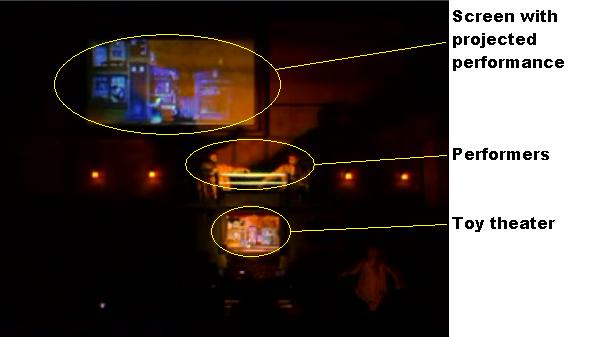
[Playwright]'s play is very cinematic. We cross continents in the blink of a scene change, cross vast amounts of time in mere moments. To help handle these transitions, I'm utilizing toy theater. (As it so happens, a few of these transitions involve large crowd scenes. Yet another reason to utilize toy theater.)


A successful application of toy theater in contemporary theater has been to capture the performance with a video camera and project it on a screen for the audience to view. (See image from Redmoon Theater's production of Once Upon a Time [Or the Secret Language of Birds].)


[Playwright] has postulated that Juana was able to keep up with what was going on outside her prison walls by way of extended or remote viewing. At the same time she was in Burgos, a group of Christian mystics were studying this phenomenon. In our play, Juana experiences two visions. We will play out these visions with shadow puppets, a form of puppetry uniquely suited to depicting dreams and visions.


Juana was was a threat to the establishment, and was removed from power. She was placed in the room without light "for her own good," and every attempt was made by her captor (the devious Marquis of Denia) to drive her insane. It was a nightmare scenario, and one that Juana briefly emerged from in 1520 when she presided over the legislative assembly in Spain, demonstrating a soundness of mind and intelligence as she attempted to transform Spain into a democracy.
"The use of puppets in this production will enable an expressionistic take on her story. The audience will experience the madhouse in which Juana found herself: surrounded by monsters who meant to do her in."
The use of puppets in this production will enable an expressionistic take on her story. The audience will experience the madhouse in which Juana found herself: surrounded by monsters who meant to do her in. In the case of Fernando, he will be a nine-foot-tall pageant style puppet. (This particular point, how Juana perceived those around her and how this works with the puppets is a point I discussed with [Playwright]. He was rather excited about the idea, and took a copy of my initial sketches to show around.)

Furthermore, we will be designing the puppets and creating an environment informed by the sort of things that would have served as nightmare fuel for a much younger Juana, growing up in the castles and cathedrals of the Catholic Monarchs. Specifically, Late Medieval and Early Renaissance religious art.

Monday, April 28, 2014

Killing Juana (Part 1)

- or -

Follow-through, Sunk Costs, and Producing the Best High School Theater in Los Angeles: A Cautionary Tale


Prologue

On September 30th, 2007, eight months after committing to direct Juana and two months before opening, I sent an email to the assistant artistic directors of [theater company name redacted] and my stage manager:

I feel a bit like Aeschylus.  Only, instead of an eagle dropping a turtle on my bald head and killing me, it's the Fates dropping Cleveland steamers on my beautiful and full head of hair.
I find myself in the position of saying "Juana can still come off, so long as ..." and then listing off a dozen or so things -- a list that grows longer each day.  The more problems I work on solving, the more problems pop up in their place.  It's been a lot like beheading a hydra.  Or to paraphrase Samuel L. Jackson's character in "Jurassic Park," we have all the problems of a major theme park and a major zoo.

Okay.  To recap:  I just this night lost the costume designer.  There's a lighting designer in the works, but I have no set designer or sound designer. 

I still don't have the cast I need (six actors short) after losing [Actress] in a Melrose-Place-like display of drama.  Of the company members who haven't quit or gone on LOA, at least half of them are taking a break -- from [Theater Company], if not from acting.  Our Now Casting responders were mostly females interested in the Toy Theater.  Of the three guys I saw, I was able to cast one.   Planet Juana needs men.

The budget's still up in the air and we really need to start the build, if we hope to build an ass-load of puppets in eight weeks.  This means some of the puppets wouldn't get into the hands of the actors until opening (eight weeks).  67 puppets is a lot.  I've simplified the design down to something doable, and I'm thinking up ways to eliminate extraneous characters, but it's still a shitload of work (see point above about remaining company members who are taking a break).
 
The breakdown of the characters/puppets."Emphasis on the 'breakdown.'"
[Artistic Director] doesn't like the idea of going dark over Thanksgiving, which means either opening after (and running for three weeks) or somehow casting nineteen people who don't have plans that weekend.  I don't know what the hell this even means.  If we start after Thanksgiving, we run for three weeks.  (Christmas is on a Tuesday this year.  Something tells me a "five day weekend" is going to be a popular choice amongst the cast members I have, let alone the audience.)

Three nights a week are completely shot as far as rehearsals go.  (Even if I was not in Midsummer, most of my cast is.) 

[Deceased Playwright]'s not here to make any needed changes to the script to make it more producible.  There are certain staging problems that I was willing to fix, but given the mounting issues around this production ... well let's just say my optimism is fading (i.e., projectors, for a start) and time is running out.

Ladies and gentleman, I'm finally to the point where I can say with a clear conscience, "This play is fucked."  Another way to say it is, "This project is officially out of my pay range." Another would be "Hold! Or cut bow strings!"  Still another would be "NO MAS!"  (This is me just being funny and softening the blow.  I honestly don't see how we can do the production with the given circumstances, and I'm supposed to be the captain of this ship.)

Let's just do it next year.  Give ourselves some time and space.  Let everyone's batteries recharge so I have a fresh, full company to play with.  Let's give half the Juana dates to the long-suffering Playwright's Labbers.  With some of the press stating that they won't review the same small theatre twice in a row, this will get the new playwrights an opportunity to be reviewed.  With the other half, let's pick back up on something we were working on earlier this year, and push it over the f-ing finish line -- and make some damn money.  I'll happily take the reins of it and see it through.  I even have a new name and face for it.  [Asst. A.D #1] and [Stage Manager] heard the first draft of the title today in the company meeting:

"Uncle [Company Member]'s Dirty Music Hall Review" --  [Company Member]'s dirtiest songs, a couple of crude puppet shows, and a couple of burlesque acts.  I'll direct and write whatever is needed to fill out the show.  Midsummer has proven that we have some great dancers on our hands.  We have the poles to do [Company Member]'s "Pole Dancer" number.  Let's have some fun, raise some money, and start the planning for next season.  (I'll even pay to reprint the outside of our Midsummer programs to reflect the change.)  $20 to $25 admission for a bawdy evening of fun would be within the budget of our audiences. [Ed. Note: We were actually in production on a "gala" show that had these elements in play. It was cancelled by the artistic director.]

I hate this.  Believe me, I was roaring about "doing Juana by myself with finger puppets if need be" a couple of weeks ago.  I don't have the energy left at this point to do a one-man Juana production, much less the flailing project I have in my hands right now.  This sucks.  But Midsummer is a high point in our season that could extend if we focus our efforts.  The New Playwrights Series should be easy to tackle with our available talent and will be great for the company.  Making money with dirty songs and half-naked women would be a great, simple and delightful way to cap off the year.

I don't know how to present this to [Artistic Director].  You guys are the experts on that.  I don't want to half-ass a dead man's work.  With Midsummer, I feel the company is rounding a corner.  I'd rather keep going onward and upward.

-- Andrew

And So We Begin

Let's go on a journey, dear reader. A journey into the room without light. A journey into attempting the impossible and failing miserably:

"But director Andrew Moore has made so many unfortunate choices and has been saddled with so many unhelpful circumstances, the story of the betrayal of Juana ... over 30 years by her father, husband, and son feels exhausting."
- from the Backstage West review of Juana

I'm going to take you on a journey through those many unhelpful circumstances and unfortunate choices.

In 2007, I undertook to direct a play about Juana the Mad, a fascinating historical figure, for a local theater company. I approached the process full of enthusiasm, the best of intentions, and a real desire to share Juana's tragic story. The final product was, indeed, a tragedy. A tragedy, it turns out, that could have been quite easily avoided (but you'll have to wait for the punchline, folks.)

The best of intentions: Pre-production art of what one of the puppets would look like.


The final product.

The day after I sent my plea to postpone the production of Juana, after receiving emailed pep-talks from the assistant artistic directors and my stage manager, I sent another email. This one began as follows:
Guys -

Okay, so I got a bit steamed up yesterday.

I took a fresh look at the script today and ... uh, started rewriting it.  

In the end, I have no one to blame but myself. I realized what I had gotten myself into, yet I fooled myself into believing I could somehow muscle Juana to completion. I hope that over the course of this series you will learn from my mistakes.

Workshopping a dead man's script during production. Item one fifty-one on the Juana glitch list.

A Few Notes

Before I dive into the gnarly details, a few notes:
First, I'm redacting all the names involved. This production of Juana is a matter of public record, and a simple Google search could easily turn up the details I'm omitting. I ask that you don't. I am certain the other people involved in this project are happy to have it well in their rearview mirror, and would rather have it forgotten.

I have nothing but lasting respect for my cast and crew. From the lighting designer who most likely wanted to flay me alive as the demands of the production maxed out the capabilities of the light board, to the actors who remained dedicated to the farce despite every reason to run for the hills, to the assistant artistic directors who were basically handed a live grenade as the artistic director ran off to New York -- everyone actively involved in this production came to it with the sort of esprit de corps that draws me to the theater.

Finally, if you were there, too, and wish to take me to task, correct my misconceptions, or contribute to the public dissection of a long-dead production, drop me a line. As always, I'm fascinated to know what other people were thinking.

Remembering Werner and Bob

One of the beautiful things about theater is the relationships you form.  In some cases, those relationships last a lifetime. I'm marrie...